Meade 285 Telescope Manuals

Garden product manuals and free pdf instructions. Find the user manual you need for your lawn and garden product and more at ManualsOnline. MEADE Product Instruction Manuals. Model 285 60mm (2.4') Equatorial Refracting Telescope Meade 60AZ-T/Compact Refractor Model 390 90mm (3.5').
• 36 Answers SOURCE: If there is nothing on the objective lenses or eyepiece lenses then it most likely needs collimation. This is where you adjust the secondary mirror while viewing an out of focus star. You need stable sky conditions to do this. There are most likely three small screws at the front of the telescope and these are what you use to adjust it. As one screw is loosened then another is tightened. Do this in very small increments. If you have your manual it should outline how to perform this.
If not go to this web site: It will show examples of how objects look both in and out of collimation. There is a section further down the page for SCTs. A very handy tool for this is to replace your screws with Bob's Knobs (. These replace the screws and allow you to adjust it by hand instead of a screwdriver.
The other focusing problem I've experience with my Celestron SCT is to have the focus knob loosen up and then slip as I turned it so that I could never focus with it. Good luck and clear skies!
-jodair Posted on Mar 30, 2009.
The Model 4500 provides stunning optical performance on the Moon, planets, and in deep-space, where its larger aperture is most advantageous. The telescope includes a high-precision equatorial mount with manual slow-motion controls on both axes. The all-aluminum tripod allows for a solid, but lightweight, observing platform. #531 Electric Motor Drive: For fully automatic tracking of astronomical objects, the Meade #531 Motor Drive is available for attachment to equatorial telescope Models 285, 395, and 4500.
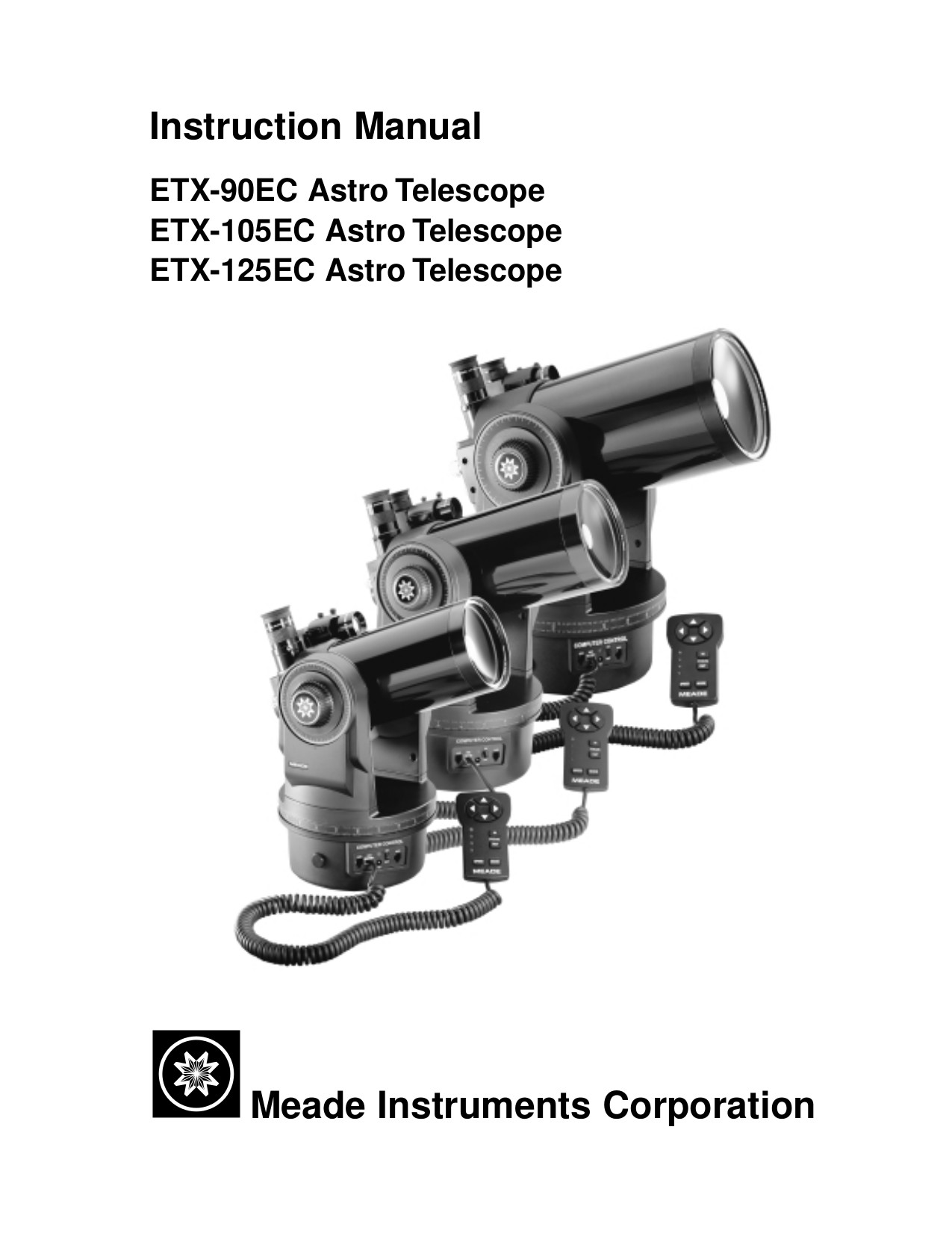
A Word about “Power:” When buying a telescope one of the least important factors to consider is the power, or magnification, of the instrument. The key to observing fine detail, whether on the surface of the Moon or on a license plate one mile in the distance, is not power, but aperture- i.e., the diameter of the telescope’s main (objective) lens or primary mirror. The power at which a telescope is operating is determined by the eyepiece employed; all Meade telescopes include one or more eyepieces as standard equipment, and optional eyepieces are available for higher or lower powers. Within reason power is useful, but the most common mistake of the beginning observer is to “overpower” the telescope and to use magnifications which the telescope’s aperture and typical atmospheric conditions can not reasonably support. The result is an image which is fuzzy, ill-defined, and poorly resolved, through no fault of the telescope. Keep in mind that a smaller, lower-power, but brighter and well-resolved, image is far superior to a large, high-power, but dim and poorly-resolved, one. How to Calculate Power: The magnification, or power, at which a telescope is operating is a function of the focal length of the telescope’s main (objective) lens (or primary mirror) and the focal length of the eyepiece employed.
The focal length of the objective lens is the distance between the lens and the point at which it brings light rays to a focus; this focal length (in mm) is printed on a label affixed to the optical tube of every Meade telescope. The focal length of each eyepiece (which typically ranges from 4mm to about 40mm) is printed on the upper surface of the eyepiece. To calculate power, divide the focal length of the eyepiece into the focal length of the objective lens.
Ab tutor control 6 crack download. I would say that any reading of the law indicates that students should never be able to log in as a teacher as they would then have access to confidential information. Why do the kids know the username and password combo for the teacher?