Black Body Radiation Experiment Pdf Writer
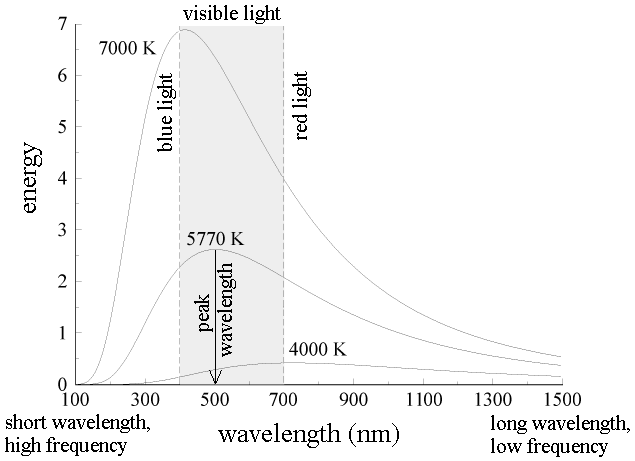
In this experiment designed for use with PASCO Capstone software, the classic blackbody spectrum of light intensity versus wavelength is obtained for a light bulb and the shift in the peak wavelength is demonstrated for different bulb temperatures. The spectrum of an incandescent light bulb is scanned by hand using a prism spectrophotometer, which measures relative light intensity as a function of angle. A Broad Spectrum Light Sensor is used with a prism so the entire spectrum from approximately 400 nm to 2500 nm can be scanned without the overlapping orders caused by a grating. The wavelengths corresponding to the angles are calculated using the equations for a prism spectrophotometer. The relative light intensity can then be plotted as a function of wavelength as the spectrum is scanned, resulting in the characteristic blackbody curve.
For black-body radiation is described by the Planck. Spectrum of black body radiation. A(r) = A0 sin(k r) = A0 sin kr, where k = 2π/λ. Wave vectors will prove to be very. 10.1 shows the results of a typical experiment, which are. Radiation, while a host of experimenters labor ed over heated bod - ies to fix temperature, determine intensity, and characterize deviations fr om blackbody ideality (see the graph above).
The intensity of the light bulb is reduced, reducing the temperature, and the scan is repeated to show how the curves nest with a shift in the peak wavelength. The temperature of the bulb's filament can then be measured indirectly by determining the resistance of the bulb from the measured voltage and current. From the temperature, the theoretical peak wavelength can be calculated and compared to the measured peak wavelength. Note: The results are qualitative, and suitable for introductory classes only. PASCO Advantage: The light bulb is powered by the interface, making it easy to change its temperature by changing the voltage across the bulb. All the complex calculations for the angle-to-wavelength conversion are stored in the setup file for PASCO Capstone.
• Understand and observe the concept of Heat Transfer, by measuring the temperature distribution for steady state conduction of energy through a specific efficient unit. • Understand the Fourier Law of heat conduction and the usage of its equation in determining the rate of heat flow via solid materials.
.UNSTEADY STATE HEAT TRANSFER Heat transfer processes are prominent in engineering due to several applications in industry and environment. Heat transfer is central to the performance of propulsion systems, design of conventional space and water heating systems, cooling of electronic equipment, and many manufacturing processes (Campos 3). Unsteady state conduction is the class of heat transfer in which the temperature of the conducting medium varies with time and position. This occurs frequently in industrial processes, especially food preservation and sterilization, where the temperature of the food or of the heating or cooling medium constantly changes (Farid2). The work reported here involves the investigation of unsteady state heat transfer in two cylindrical rods and the conformity of experimental results to different methods of theoretical analysis. Ansys autocad import dwf. Aluminum and Plexiglas cylinders were used.
Thermocouples were placed at different radial and axial positions, and the cylinders, which were in thermal equilibrium with an ice bath, were placed in a warm water bath at 370C. Temperature profiles were obtained using a data acquisition system on a computer. Theory The applicable form of the heat transfer equation for conduction in solids is given by (Welty1): ρcp∂T∂t=∇∙k∇T+q. .DEPARTMENT OF CHEMICAL ENGINEERING NATIONAL INSTITUTE OF TECHNOLOGY KARNATAKA SURATHKAL - 575025 HEAT TRANSFER LAB MANUAL (July- November, 2013) List of Experiments S.No Date Experiment Remarks Observation Calculation 1. Thermal Conductivity Of Insulating Powder 2. Thermal Conductivity Of Liquid (Guarded Plate Method) 3.
Transient Conduction With Constant Heat Flux 4. Stefan Boltzmann Apparatus 5. Fungilab viscometer.
Natural And Forced Convection In Air 6. Natural And Forced Convection In Water 7. Heat Losses By Combined Convection And Radiation (For Cylinder And Sphere) 8. Pool Boiling Apparatus 9. Heat Transfer Through Coils 10. Double Pipe Heat Exchanger 11. Spiral Plate Heat Exchanger 12.
Packed Bed Heat Exchanger 13. Vertical And Horizontal Condenser 14. Shell and Tube Heat Exchanger Experiment No: 1 Date: THERMAL CONDUCTIVITY OF INSULATING POWDER AIM OF EXPERIMENT To determine thermal Conductivity of Insulating Powder. APPARATUS DESCRIPTION: - The apparatus consists of two thin walled concentric spheres of copper of different size.